
A Letter to Anyone in Fort Lauderdale Who Has Something They Need Gone
You can read the history of this city in what people throw away.
I have carried terrazzo tile out of houses in Croissant Park that was poured before the war. I have carried jalousie windows out of Coral Ridge ranch homes that went up in the fifties, when a young family could buy a concrete block house with a carport and a Florida room and figure the rest out later. I have carried rattan sofas and mirrored headboards out of Galt Ocean Mile condos that were the height of taste in 1979. I have carried out the flat-pack bookcases and the sectionals that were put together inside apartments in Flagler Village that did not exist ten years ago.
Every era of Fort Lauderdale eventually ends up in the back of a truck.
That is not a sad thought, or at least it does not have to be. A city that never changed would be a museum. Fort Lauderdale is not a museum. It is a place that gets torn down and built up and rearranged constantly, and every one of those rearrangements starts with somebody standing in a room saying, “All of this has to go, and I have no idea how.”
That is the moment I want to talk to you about.
Because if you are reading this, you are probably standing in that room right now. Maybe it is a garage. Maybe it is a rental unit that a tenant left in a hurry. Maybe it is an office with a lease ending. Maybe it is a house where your mother lived for forty years, and you are trying to figure out how a person is supposed to make ten thousand decisions in a weekend.
I am not going to tell you it is easy. I am going to tell you what I have learned, and then let you decide whether you want help.
Junk removal looks simple until you are the one doing it Here is the thing nobody tells you.
Almost everything in a Fort Lauderdale home came in easier than it will go out. The sofa came in through a door that was propped open by a delivery crew with a dolly and
a clear morning. The sleeper sofa in the den came in as a box and was assembled in place. The armoire came in before the bookshelves were built around it. The workout equipment came in piece by piece and was bolted together in a spare bedroom on a Saturday when you had energy.
Now it all has to leave, and the door is the same size, but the circumstances are not.
You have a bad back, or a bad knee, or simply a job and a life that leaves no room for spending Sunday fighting a queen box spring around the corner of a hallway. Your building has rules about when things can move through the lobby. Your street has no place to leave a truck. It is August and the humidity is sitting on the city like a wet towel.
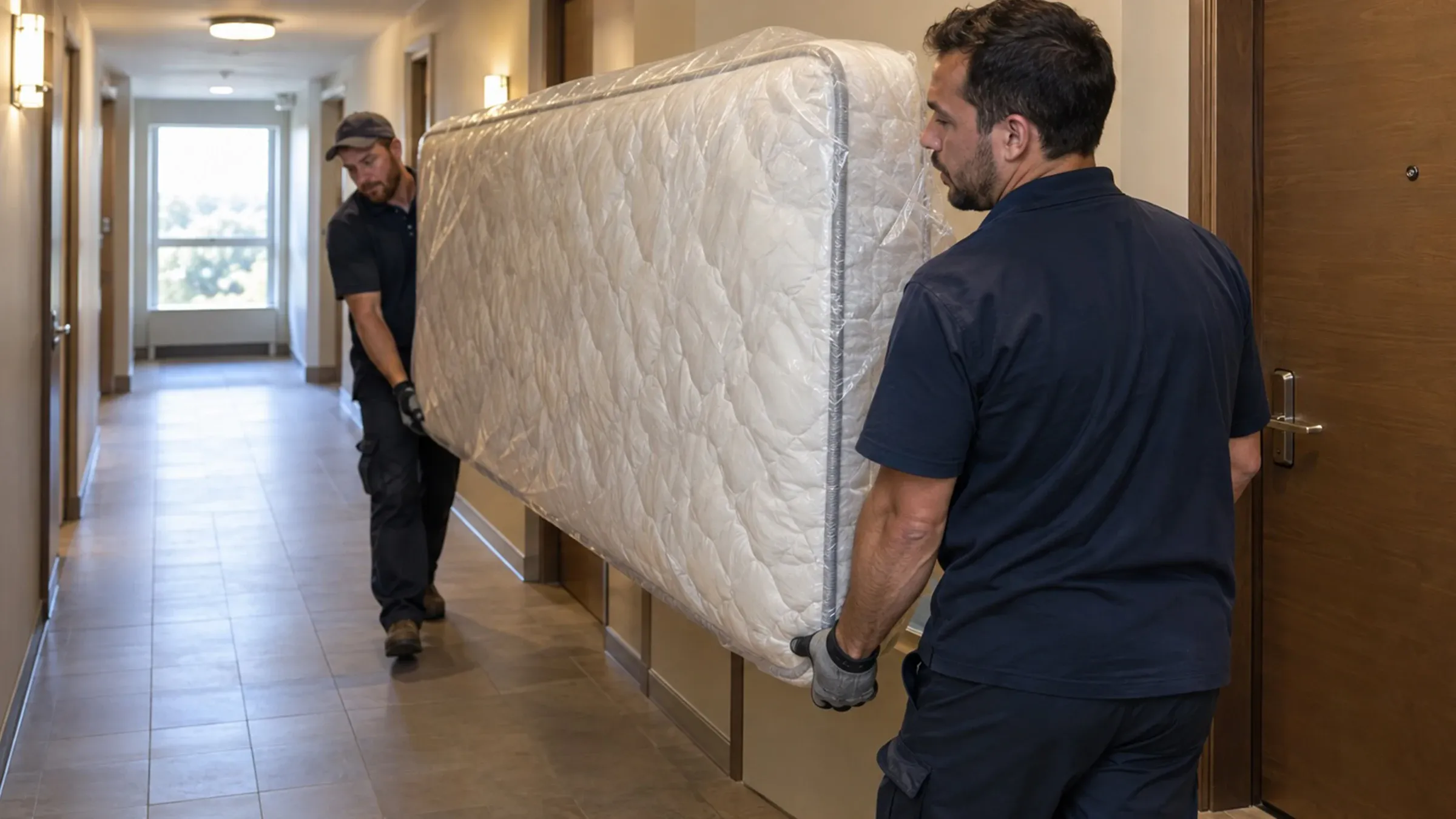
And that is a single sofa.
Multiply it by a garage. Multiply it by a storage unit off State Road 84 that you have been paying for since a move you have half forgotten. Multiply it by an entire house.
The work itself is not complicated. I want to be honest about that. Anybody can lift a chair. The difficulty is everything around the lifting: the planning, the access, the sorting, the disposal, the fact that you have to be there, and the fact that most people have never done it before and do not know what they do not know.
That is the gap I fill.
What this city does to belongings
Fort Lauderdale has a few habits that make cleanouts different from cleanouts almost anywhere else.
The first is the water.
Roughly a third of the year, the air here is heavy enough to grow mold on a leather chair in a closed room. Anything stored in a garage, a shed, a Florida room without air conditioning, or a first-floor unit near a canal has been living in that humidity for years. Cardboard boxes go soft. The particleboard swells and crumbles when you lift it. The bottom drawer of a dresser that has been sitting on a slab since Hurricane Wilma has a very good chance of falling apart in your hands.
I know this, so I plan for it. Someone who has never done a cleanout in South Florida finds out the hard way, usually with a drawer full of old tax documents spilling down a driveway.
The second habit is the seasons, and I do not mean weather.
This city fills up and empties out every year. Seasonal residents arrive around the holidays and leave around Easter. A great many of the condos along the beach, the Intracoastal, and
The Galt are owned by people whose primary address is in New Jersey, or Quebec, or Ohio. When one of those owners passes away, or stops coming down, or decides to sell, the family is usually handling the property from a thousand miles away.
Those people need someone local they can trust to walk through the unit, tell them honestly what is there, and handle it without them having to fly down three times.
The third habit is the buildings themselves.
Fort Lauderdale has a lot of high-rise living, and a lot of it is older than people think. Plenty of the towers on the Galt and along the beach went up in the sixties and seventies. Since the state started requiring milestone structural inspections for older condo buildings, a good number of longtime owners in those buildings have looked at the assessments and the reserve requirements and decided it is time to sell. When they do, decades of belongings have to come down an elevator that the building controls, through a lobby the building controls, on a schedule the building controls.
If you have never moved anything out of a Fort Lauderdale condo, you would be amazed at how much of the job is the building and how little is the furniture.

The condo problem, explained
Let me spend a minute on this, because it is the single most common way a “simple” job in this city turns into a headache.
Most controlled-access buildings on the beach, along Las Olas, downtown, and up the Galt have some version of the same rules. Moves and large removals happen in a window, often weekday business hours. The freight elevator has to be reserved. The elevator has to be padded, and sometimes the building has its own pads that only building staff can hang. There is a loading area, and it is often shared with delivery trucks, movers, and contractors who are all trying to use it the same morning. Some buildings want a certificate of insurance from any company doing work on the property before they will let a truck in.
None of this is unreasonable. The building is protecting a lobby that costs a fortune to maintain and an elevator that everyone depends on.
But it means the job has to be planned. Somebody has to call the management office, find out what the rules are, book the window, and then show up when they said they would with a crew that can move fast enough to finish inside the window. If a crew loses an hour because the elevator was not reserved, that is not an hour you get back. The building will not extend the window because the truck was late.
I have watched people try to do this themselves with a couple of friends and a borrowed pickup. They get one load down and the building manager shuts them off for the day
because they were not on the schedule.
I have also watched companies from out of the area take these jobs, show up with no idea what building rules are, and leave the customer to sort it out.
Knowing how buildings in this city work is not a bonus. It is the job.

Old Fort Lauderdale houses have their own rules
Now go west of the Intracoastal, into Victoria Park, Rio Vista, Sailboat Bend, Tarpon River, Poinsettia Heights, Croissant Park, Lauderdale Isles, Imperial Point. A different set of problems.
These are older homes, a great many of them concrete blocks built between the twenties and the sixties. Doorways are narrower than what modern furniture was designed for. Hallways bend. Some of the pretty older houses in Rio Vista and Victoria Park have stairs that were never meant to pass a king headboard. Some houses have had additions built onto additions, so the only way from a back bedroom to the driveway goes through three rooms and a kitchen.
The properties are also shaded and lush, which is lovely to live in and terrible to haul through. A long carry down a side yard under a mango tree in July is a real thing that a crew has to be ready for.
And a great many of these homes sit on lots where a full-size truck cannot get close to the house. Narrow streets. No shoulder. Sometimes a swale turns to mud after a normal afternoon storm, let alone what happened in Edgewood and River Oaks in April of 2023, when more than two feet of rain fell in a day and homes near the airport ended up with water inside them. Cleanouts after that were a different category of work entirely.
Older houses also hide things. Attics in this climate are brutal, so people stopped using them and forgot what was up there. Garages became storage and then became sealed. Sheds in the backyard have been closed since the last hurricane season somebody bothered to prepare for.
The right way to approach an older home is slowly at first and quickly after. Walk it. Understand what is there and how it has to come out. Then move.
What actually happens on a cleanout
I want to describe the work plainly, because most people have only seen it on television, and television is not accurate.
A good cleanout starts before anybody lifts anything.
It starts with photographs, if you can send them, or a walkthrough if the property is nearby. Pictures of a garage, a room, a unit, a pile in a driveway, tell me most of what I need to know about volume, weight, access, and what kind of materials are involved. Volume is what the job is really about. A truck holds a certain number of cubic yards, and an experienced eye can look at a room and know roughly how many trucks it represents.
Then there is a conversation about what stays and what goes. This sounds obvious. It is where most of the trouble in this business comes from. A crew that starts loading before that conversation is finished is a crew that will eventually throw away something that mattered.
Then there is the plan for the day. Where does the truck go? What is the path from the farthest room to the truck? What has to be protected along that path: floors, door frames, the corner of a wall in a hallway that every sofa in the world wants to hit. What needs to come apart to fit through a doorway. What comes out first so that everything else has room to move.
Then the crew loads. The heaviest, bulkiest, most awkward things go first while everyone is fresh, and the loose material fills in around them. A well-loaded truck carries more and costs the customer less. A badly loaded truck is half air.
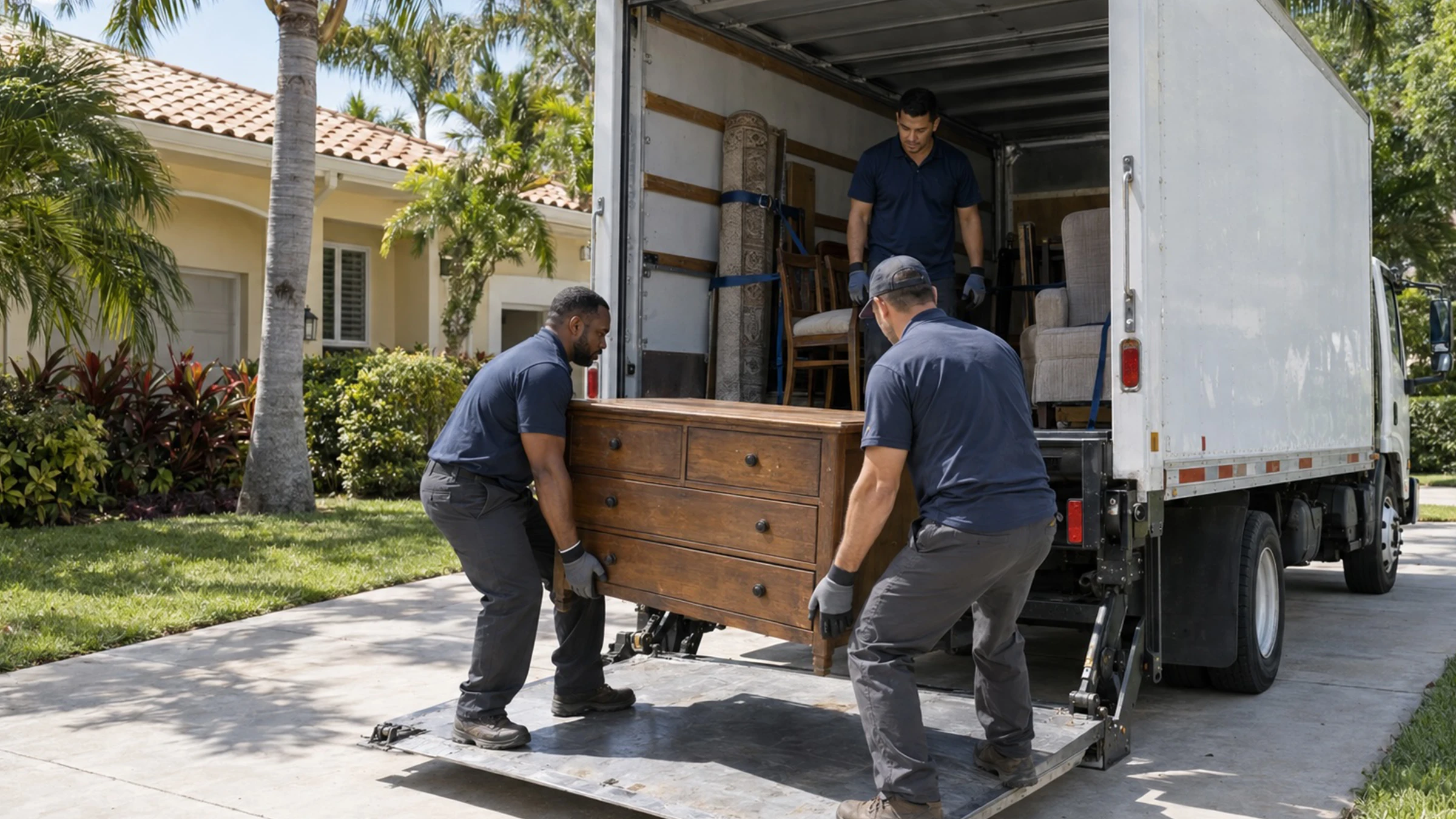
Then it goes somewhere.
This part matters more than most people realize, so let me stay on it.
Where things go, and why it matters
Fort Lauderdale residents in single-family homes have a monthly bulk pickup from the city. That is a good program, and I tell people to use it when it fits. But it comes once a month, on a schedule, with a limit on how much can go out, and it does not apply to condos or to most rental buildings. It is for a mattress and a couple of chairs on the right week. It is not for a house.
Beyond that, Broward County has its own landfill and transfer stations with their own rules about what they accept and from whom. Construction and demolition material is handled differently from household bulk. Appliances with refrigerants have to be handled properly. Electronics have their own path. Tires, paint, and certain chemicals cannot simply go into a load with everything else, and a company that tosses them in is creating a problem somewhere down the line, sometimes for the customer whose address is on the ticket.
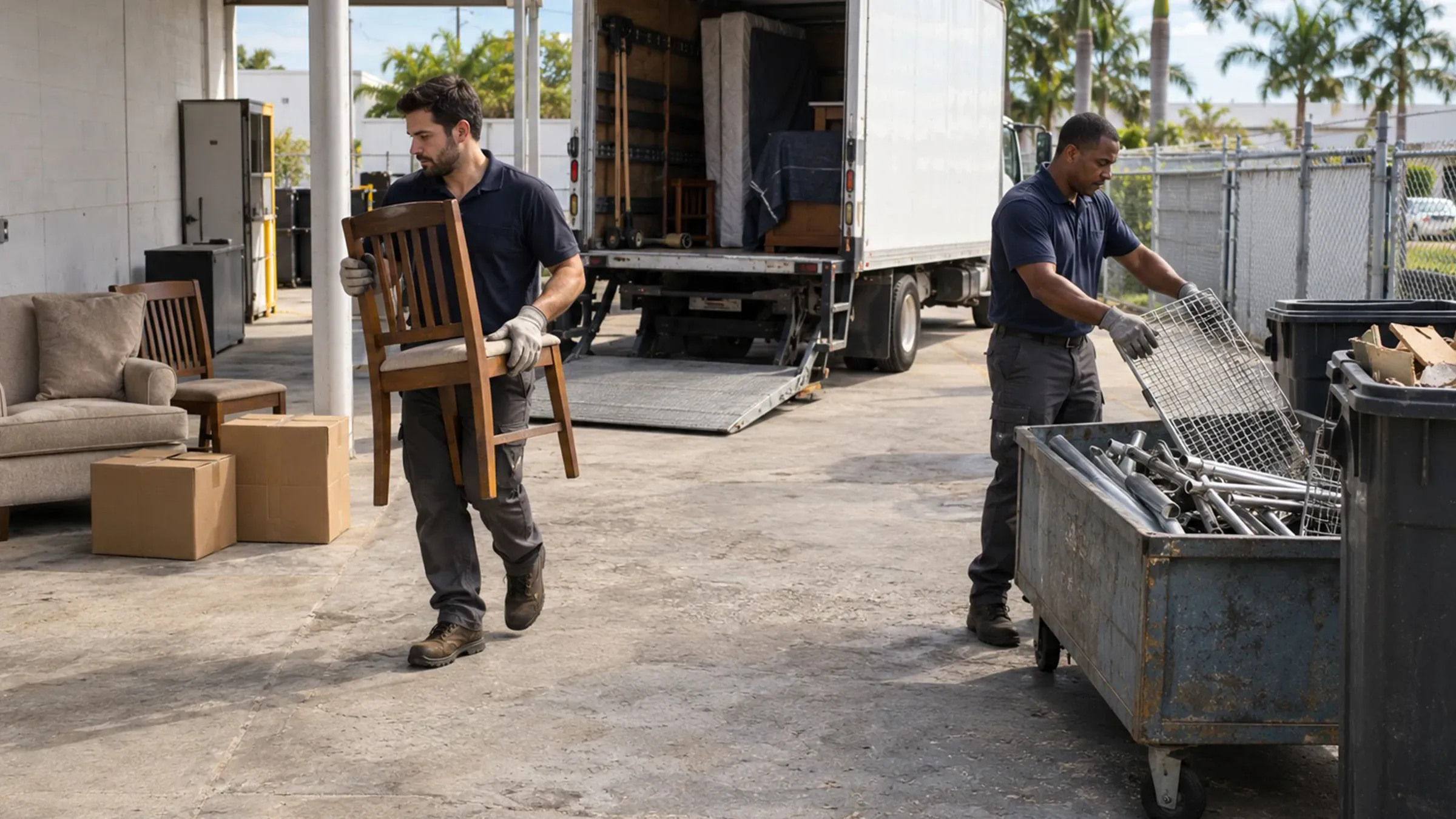
I mention this because there is a kind of operator in every market, and Fort Lauderdale has plenty of them, who will quote you a very low price on a phone call and then either add to it once the truck is loaded, or make the price work by dumping the load somewhere it should not go.
A load of somebody’s belongings turning up in a swale in an industrial area off I-95 is not a hypothetical. It happens. And the low quote that made it possible was never really the low quote.
What I mean by “careful”
People use the word careful a lot in this line of work. I want to say what it means to me, because the difference between a careful crew and a fast crew is usually invisible until something goes wrong.
Careful means the crew looks at the door frame before the dresser goes through it, not after.
Careful means the floor in the hallway gets covered when it is terrazzo or wood, because a metal chair leg dragged across terrazzo leaves a mark that stays.
Careful means when a sofa will not fit out the way it came in, the crew stops, thinks, and takes the legs off or removes the door from its hinges, rather than forcing it and taking a chunk of plaster with it.
Careful means someone checks the drawers before the dresser goes in the truck. You would not believe how often there is something in a drawer.
Careful means the crew asks before touching anything that was not clearly marked for removal.
Careful means the truck is not overloaded, the load is secured, and nothing blows off on Sunrise Boulevard.
Careful is slower by about ten percent and better by a lot more than that.
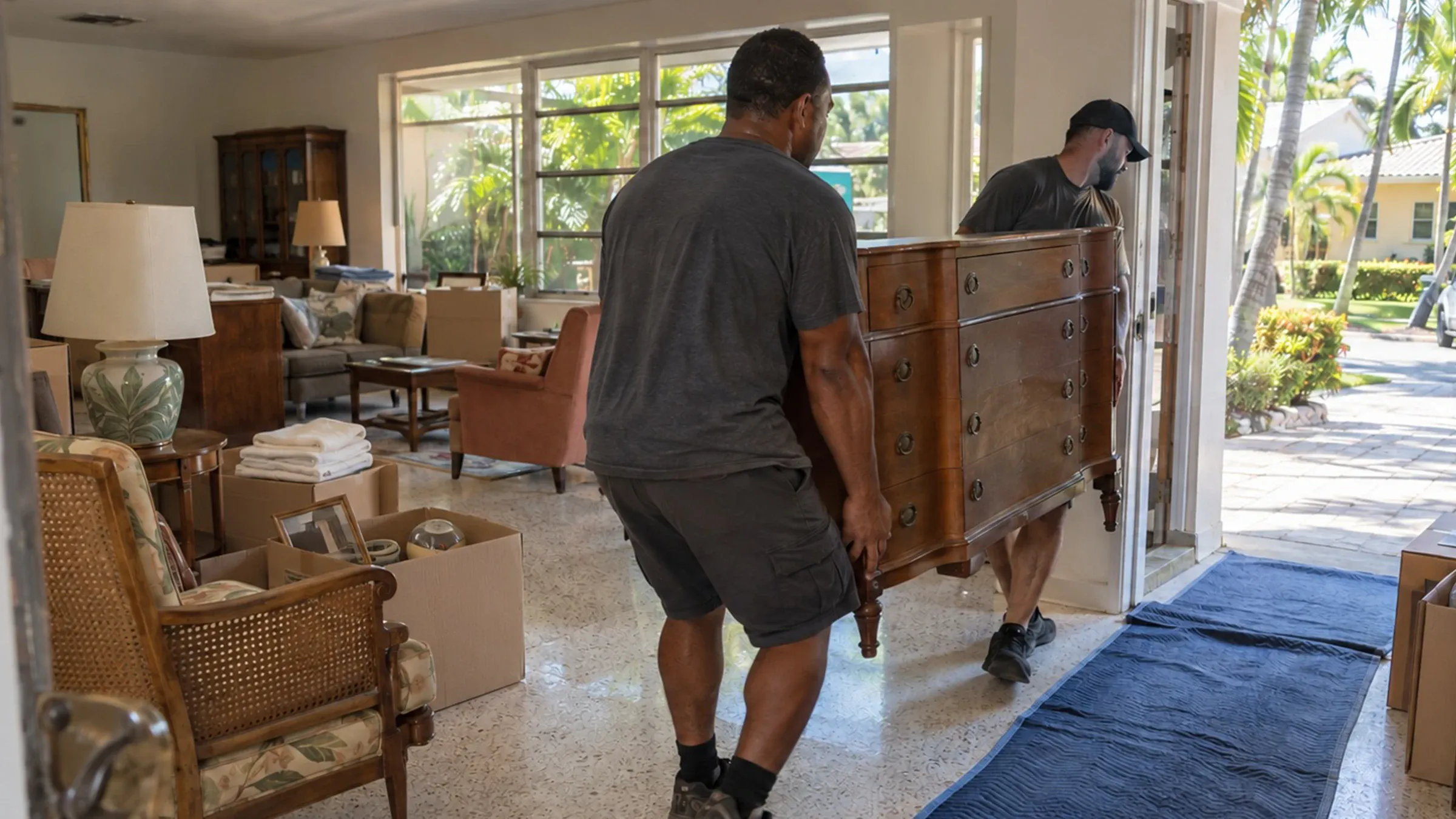
Estate cleanouts are a different kind of work
I want to be direct with you about estates, because it is the part of this business where the stakes are highest and where I have seen the most harm done by people who did not understand the assignment.
An estate cleanout is not junk removal that happens to be large.
When a parent dies, or moves into assisted living, the house they leave behind is full of two
different kinds of things that look identical from across the room. There is what has to go, and there is what cannot be lost. The problem is that they are mixed together, and the people responsible for sorting them are grieving, tired, often on a deadline, and frequently not in agreement with each other.
I have been in living rooms in Coral Ridge where three adult siblings could not agree about a dining table, and the table was not really what they were arguing about.
I have seen a box of what looked like old bills turn out to contain a deed, a life insurance policy, and the only copies of photographs from a wedding in 1958.
I have seen jewelry in a coffee can. Cash in a book. A father’s tools that were worth almost nothing to a buyer and everything to a son.
So the way I approach an estate is not the way I approach a garage.
We go slower at the front. We establish what the family has already pulled out and what they want pulled out. If they are still deciding, we do not push. We are happy to clear one room so they have space to think, and come back for the rest. If a family member lives out of state and cannot be there, we can walk the property with them on the phone or on video before anything moves. When we find something that looks like it might matter, a document, a photograph, an envelope, a piece of jewelry, it gets set aside, not loaded.
I do not appraise anything. I am not an attorney, an executor, or a fiduciary, and I will not pretend to be. What I can do is make sure that the people who hold those roles are not handed a house where everything is already gone.
And I can do it without making anyone feel rushed. A family standing in their parents’ home does not need a stranger looking at his watch.

Rentals, and getting a property back
Landlords and property managers in this city have a specific problem, and it is a time problem.
A tenant leaves. Sometimes on good terms, sometimes not. What is left behind ranges from a few bags of trash to a fully furnished unit that nobody wants. Every day that unit sits full is a day it is not being shown, not being turned, and not paying for itself.
Fort Lauderdale is a rental market in a way most cities are not. Between the downtown apartments, the older duplexes and small buildings scattered through the neighborhoods,
the vacation rentals near the beach, and the units in condo buildings that owners lease out, there are a lot of properties changing hands every month. The management companies that handle those buildings need a removal company that can get in, get the unit empty, and get out on a schedule that works around cleaners, painters, and the next showing.
They also need one that understands that a unit in a controlled-access building is still a controlled-access building. A rental cleanout on the twelfth floor of a tower on the Intracoastal has the same elevator rules as a sale.
The same goes for commercial spaces. Offices along Federal Highway, on Cypress Creek, in the medical corridors, in the strip centers up and down Commercial and Oakland Park. When a lease ends, the space has to be returned in a condition the landlord will accept, and the furniture, the cubicles, the file cabinets full of nothing, all have to disappear on a date that was set months ago.
Some of the same rules about materials apply. A company that has emptied offices knows how much a lateral file cabinet weighs, how a cubicle system comes apart, and that the old copier in the corner does not go where the desks go.
The garage that has been waiting for six years
Not everything is a crisis. A lot of the work in this city is simply a garage.
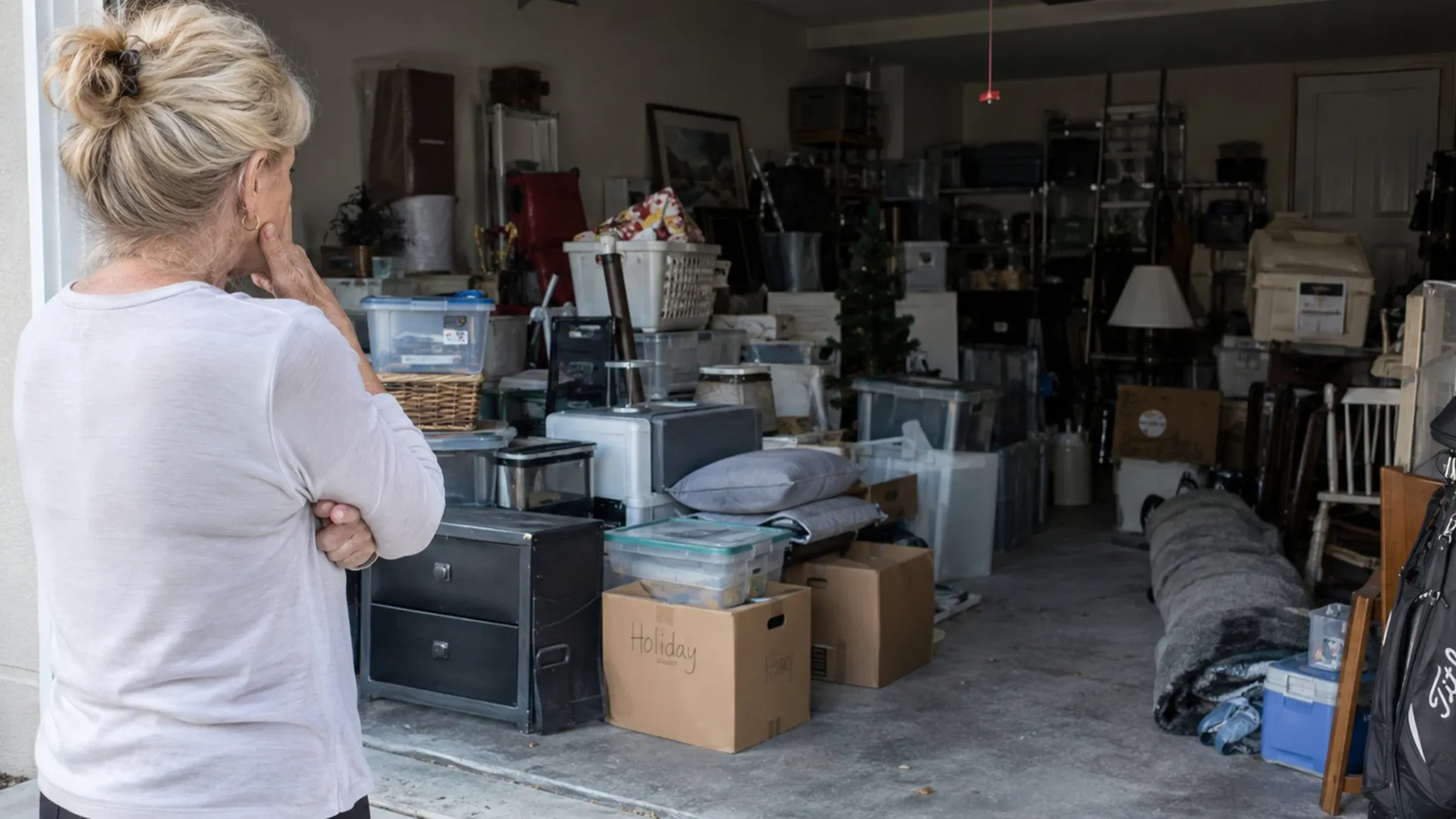
You know the one. It has not held a car since the second kid was born. It has three generations of holiday decorations, a treadmill nobody has turned on, a set of golf clubs from a phase, the boxes from the move before last, and a corner you honestly cannot see into.
You have thought about dealing with it every January. You have priced out a dumpster and then realized a dumpster in a Fort Lauderdale driveway still means you are the one filling it, in the heat, on your own weekend, with a neighbor watching.
What I would say to that person is this. The garage is not a moral failing. It is a scheduling problem. Nobody has a free Saturday in this city, and the ones who do would rather be on the water.
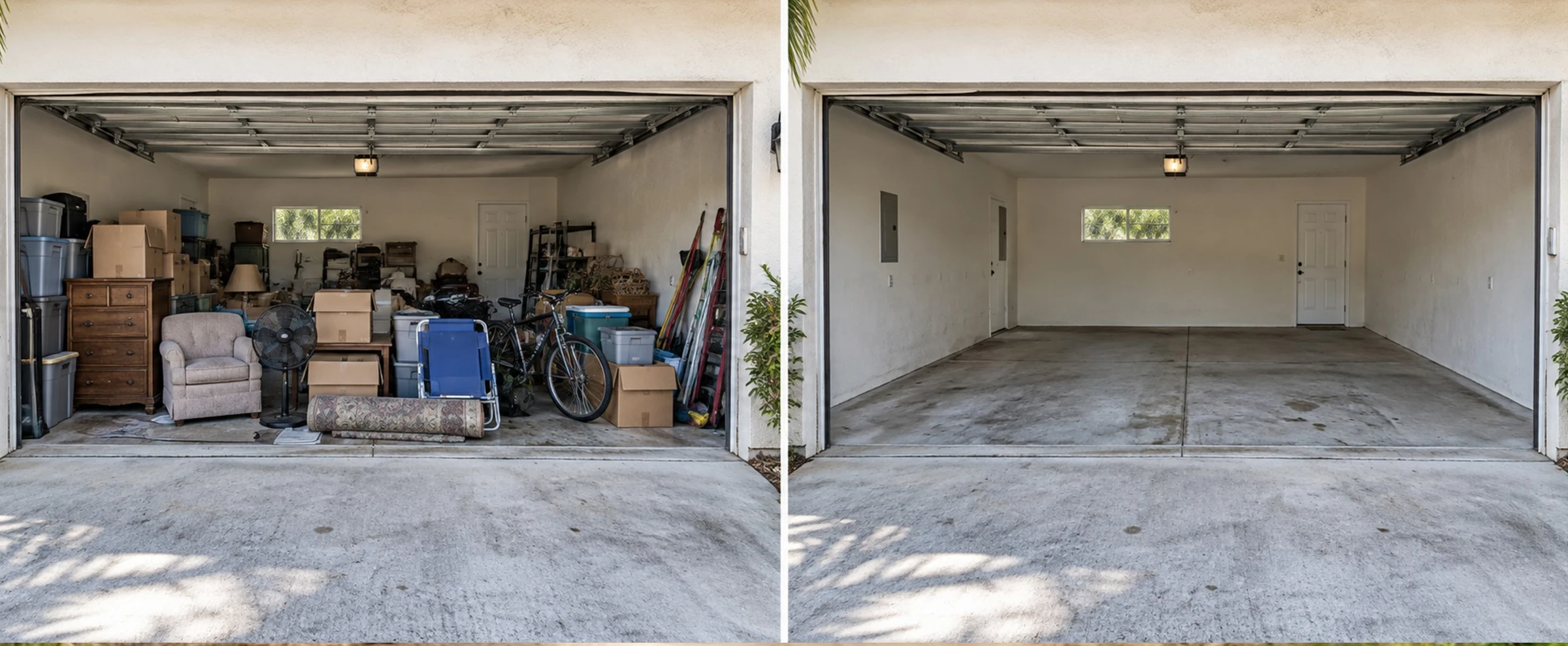
A crew can empty a two-car garage in a morning. You point, we carry. You keep what you want to keep. The rest is gone before lunch, and by the afternoon you are standing in a garage you forgot was that big, wondering why you waited.
That is not a sales pitch. It is just what happens.

Hurricane season, and the piles it leaves
Every summer this city gets the same reminder, and every year a certain number of people get around to preparing for it at the last minute.
Loose debris in a yard, an old swing set, a rotted fence, dead palm fronds stacked behind a shed, a pile of leftover roofing material from a repair two years ago: in a tropical storm, all of that becomes something that ends up in your neighbor’s pool or through your own window. Fort Lauderdale learned that lesson with Wilma in 2005 and again with Irma in 2017, and the
smart approach is to clear it out in May, not in the last forty-eight hours before landfall when every truck in Broward County is already booked.
And after a storm, the piles are a different kind of work. Wet drywall. Soaked carpet. Furniture that has sat in standing water. Fencing, shingles, screening from a lanai. Some of it is bulk. Some of it is construction material with its own disposal path. All of it needs to move before the mold does.
If you own property here, get ahead of it. If you did not, call anyway. We have seen it before.
Renovation debris is not the same as junk
Fort Lauderdale is under permanent renovation. Drive through Rio Vista or Coral Ridge on any weekday and count the contractor trucks. Flagler Village barely resembles the warehouse district it was fifteen years ago. Even the old ranch homes in Imperial Point are getting gutted and reworked one at a time.
Renovation produces a particular kind of pile: old cabinets, tile, tub surrounds, drywall, lumber, the pink bathroom that finally came out of a 1962 house. Homeowners doing their own work end up with this material in a driveway and no clear idea what to do with it, because it is not what the city bulk truck takes and it is more than a regular dumpster run.
Construction debris goes to a different place than household bulk, and it is heavier than it looks. A pile of tile and mortar the size of a kitchen table can outweigh a room full of furniture. A crew that understands weight and materials loads it differently, prices it honestly, and takes it where it is supposed to go.
Why photographs matter
I keep coming back to this because it is the single most useful thing you can do before calling anyone.
Take pictures.
Stand in the doorway of the room, the garage, the unit, and photograph the whole space. Then take a few closer shots of the biggest or heaviest things. If there are stairs,
photograph the stairs. If the truck will have to park somewhere unusual, photograph the street.
With those pictures, a company that knows what it is doing can tell you a great deal before anyone drives across town. How many loads. How many people? Whether the sofa will need to come apart. Whether the building will need to be called. Whether there is anything in the pile that needs special handling.
Without them, you get a guess. Guesses are how prices change on the day of the job.

What separates a company from a guy with a truck
I do not say this to run anyone down. Some of the best people I have known in this trade started with one pickup and a strong back. But there is a difference between a person who hauls things and a company you can hand a difficult problem to, and the difference is not the size of the truck.
It is whether they show up when they said. It is whether they call the building. It is whether they protect your floors. It is whether they can handle the surprise, the sleeper sofa with the steel frame that weighs three hundred pounds, the freezer that has been unplugged since March, the room behind the room, without changing the whole price or walking off the job. It is whether they know where the load is going before they load it. It is whether they treat the house like a house and not like a pile.
It is whether, when a family is standing in their parents’ living room, the crew understands that the job that day is not really about furniture.
That is what I try to build a company around.
What working with us looks like
Here is what happens when you contact Fort Lauderdale Junk Removal.
You tell us what you are dealing with. A room, a garage, a whole house, a unit, an office. You send photos if you can. If it is a bigger job, or an estate, or a condo with building requirements, we talk through the details before anyone shows up.
You get a straight answer about what it will take.
We handle the building if there is one. We handle the truck. We handle the carry, the protection, the sorting, the loading, and where it goes. You handle deciding what stays.
If you cannot be there, we can arrange access and walk you through the property before anything leaves.
And when we leave, the space is empty and swept, and the problem that has been sitting in the back of your mind for months, or years, is simply gone.
A few honest answers to questions people ask
Can you take everything? Almost. There are materials no legitimate company can take in a regular load, and we will tell you which ones and what to do with them.
What if I do not know what I want to keep? Then we start with what you are sure about and leave you room for the rest. Plenty of jobs happen in two visits. That is fine.
My building is strict. Most of them are. Give us the management office contact and we will handle it.
I am embarrassed by the condition of the property. You do not need to be. There is no condition we have not seen. We do not comment on it and we do not remember it. We just clear it.
If you live out of state, so do a great many of the people who own property here. We can work with you remotely.
Is the cheapest quote the best deal? Sometimes. Often it is the quote that was never really the price. Ask what happens if the job is bigger than expected, ask where the load goes, and ask whether they have worked in your building. The answers tell you most of what you need to know.
Where to start
You do not have to solve this whole thing today.
You do not have to sort every box, price every piece, call every sibling, or figure out how the sofa is going to get down the stairs. That is the part I do. The part you do is smaller than you think.
Take a few photos.
Then call or text (754) 283-2799, or send them to info@fortlauderdalejunkremoval.com, and tell me what you are looking at.
We serve Fort Lauderdale and Wilton Manors, Oakland Park, Lauderdale-by-the-Sea, and surrounding Broward County communities.
That is it. One message, and the problem stops being yours alone.
I have been in enough of these rooms to know how much lighter a house feels on the way out than it did on the way in. Let me show you.
Fort Lauderdale Junk Removal (754) 283-2799